
Call Us Now
202-960-4596
Schedule a Free Consultation

Electric bikes have become a familiar sight on Washington, DC streets, but riders need to understand the e-bike laws that apply to them. The District has specific rules governing where these bikes can be ridden, along with safety requirements that differ from those for standard bicycles.
Washington, DC regulates e-bikes under its legal definition of a motorized bicycle rather than the three-class system adopted by many states.

Under DC Code § 50-2201.02, a motorized bicycle must have:
E-bike manufacturers commonly use three classifications. Class 1 bikes provide pedal assistance up to 20 mph, while Class 2 models can also operate using a throttle without pedaling. Class 3 bikes provide pedal assistance up to 28 mph.
The key distinction for Class 3 e-bikes is that their 28 mph limit applies to assistance while pedaling. DC’s 20 mph threshold concerns motor propulsion, so the class alone doesn’t establish how an e-bike is classified under District law.
Under DC’s e-bike laws, you don’t need a driver’s license, vehicle registration, or motor vehicle insurance to ride an e-bike that meets the District’s definition of a motorized bicycle.
E-bikes that fall outside DC’s definition of motorized bicycles may be treated as other motor vehicles. Bikes classified as motor-driven cycles are subject to additional requirements, including a driver’s license and vehicle registration.
Where you can ride an e-bike in Washington, DC depends on whether you’re using city streets or trails managed by the National Park Service.
E-bikes that meet DC’s motorized bicycle requirements can be ridden on public roads and designated roadway bike lanes.
However, 18 DCMR § 1201.18 prohibits motorized bicycles on sidewalks and off-street bicycle paths. This restriction applies even when the rider is pedaling without using the motor.
Riders must also obey posted traffic restrictions and watch for pedestrians at intersections or crossings.
Separate rules apply to federally managed recreational areas, including Rock Creek Park and the National Mall.
The National Park Service allows e-bikes on designated trails in Rock Creek Park where traditional bicycles are permitted. Riders should keep their speed at or below 15 mph on paved multi-use recreational trails. Riders must pedal while using electric assistance on paths closed to public motor vehicles. Riding under motor power alone is prohibited.
E-bikes are also permitted in designated areas of the National Mall, although riders must walk their bikes through memorials where cycling is prohibited.
Rules differ between parks, so it’s worth checking the restrictions for the particular trail you plan to use.
According to 18 DCMR § 1200.10, riders must be at least 16 years old to operate a motorized bicycle in public spaces in DC.
Riders ages 16 and older aren’t required to wear helmets on privately owned e-bikes, although helmets provide important protection against head injuries.
Different rules apply to shared rental e-bikes. Under DC Code § 50-2201.03c, riders under 18 must wear helmets. Rental companies can also set a minimum age higher than 16.
E-bike riders must follow DC’s traffic laws, including the rules for intersections and riding after dark.
Key requirements include:
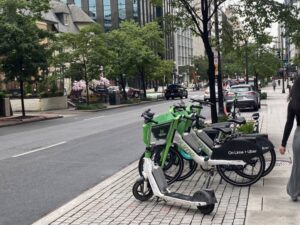
Shared rental devices have additional operating restrictions. Passengers are prohibited, and riders must park the devices upright using the required locking mechanism. Parking must leave at least three feet of unobstructed pedestrian walkway.
DC’s e-bike laws can affect who is held responsible after an accident. If a rider or motorist breaks a traffic rule and causes a collision, the violation can be important when determining fault.
DC generally follows a strict contributory negligence rule, which can prevent injured people from recovering compensation if they contributed to an accident. However, the Vulnerable User Collision Recovery Amendment Act provides additional protection for e-bike riders.
Under this law, an injured e-bike rider can still recover compensation in covered collisions, provided their share of fault is no greater than the combined fault of those responsible for the accident. This means breaking a traffic rule doesn’t necessarily prevent a rider from making a successful claim.
If you’ve been injured in an e-bike accident, Regan Zambri Long’s Washington, DC bicycle accident lawyers can investigate what happened and help you understand how DC’s laws apply to your case.


Have you or your loved one sustained injuries in Washington DC, Maryland or Virginia? Regan Zambri Long PLLC has the best lawyers in the country to analyze your case and answer the questions you may have.