
Call Us Now
202-960-4596
Schedule a Free Consultation


Making left turns on a bicycle in Washington, DC requires different techniques and legal knowledge than operating a motor vehicle. Cyclists face unique visibility challenges and vulnerability when crossing traffic lanes, particularly at the District’s unconventional intersections where diagonal avenues meet grid streets.
This guide explains DC’s bicycle left-turn laws, safe turning techniques, and your rights if you’re injured while making a left turn on your bike. If you’ve been involved in a bicycle collision in the DC metro area, the bicycle accident attorneys at Regan Zambri Long have successfully represented cyclists in serious intersection accident cases and offer free consultations to help you understand your legal options.
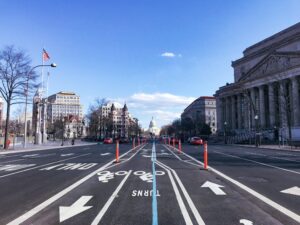 How Cyclists Should Legally Make Left Turns in DC
DC law provides cyclists with two legal options for making left turns, as outlined in DC Municipal Regulations, Title 18, Chapter 12.
Cyclists may make left turns using the same method as motor vehicles:
This method works well on quieter streets where traffic moves slowly and drivers can easily see cyclists. However, on high-speed or high-volume roads, this turning method puts cyclists at significant risk.
DC law explicitly permits cyclists to make two-stage turns, also called “box turns” or “Copenhagen lefts”:
This method is safer on busy streets because you never cross opposing traffic lanes. You complete the turn in two stages, always moving with traffic that has a green signal.
Many experienced DC cyclists prefer two-stage turns at high-traffic intersections like Connecticut Avenue and K Street NW, where vehicular left turns would require crossing multiple lanes of fast-moving traffic.
The type of traffic signal at an intersection determines whether your left turn is protected or unprotected.
Protected Turn: A green arrow signal stops oncoming traffic, giving you exclusive right-of-way to turn. These signals are rare at DC intersections, particularly on routes where cyclists commonly travel.
Unprotected Turn: A solid green circular signal means oncoming traffic also has a green light. You may turn left only after yielding to all approaching vehicles. Most DC intersections only provide solid green signals, making nearly all vehicular-style left turns unprotected.
DC Municipal Regulation Title 18, Section 2204 requires all road users—including cyclists—to yield to oncoming traffic that poses an immediate hazard. If an approaching vehicle would need to brake or swerve to avoid you, the gap is too small to turn safely.
 Cyclists sit lower than drivers and lack the visual presence of a car or truck. Motorcycle operators face similar visibility issues, but cyclists move more slowly, spending more time in the intersection where collisions occur.
Research from the National Transportation Safety Board shows that driver recognition failures contribute to a significant portion of bicycle crashes at intersections. Drivers often look through cyclists rather than at them, a phenomenon called “inattentional blindness.”
Wearing bright colors and using front lights, even during daytime, improves your visibility to drivers preparing to turn or proceed through intersections. The Washington Area Bicyclist Association recommends lights at all times for increased conspicuity.
Most cyclists travel between 10-15 mph in urban settings. Motor vehicles often exceed 25 mph even in DC’s 20 mph residential zones. This speed gap creates two problems for cyclists making left turns:
The District’s diagonal avenues create sight-line problems at major intersections. Massachusetts Avenue, Pennsylvania Avenue, and Connecticut Avenue all cut across the grid at angles, producing:
Traffic circles present additional challenges. DC operates more than 20 traffic circles, each with unique entry patterns and yield requirements. Cyclists making left turns through circles like Dupont Circle or Washington Circle must yield to circulating traffic while watching for vehicles entering from multiple approach roads.
Heavy rain reduces visibility and makes road surfaces slippery, extending stopping distances for all vehicles. Winter darkness arrives around 5:00 PM, during evening rush hour—making it harder for drivers to see cyclists and harder for cyclists to judge the speed and distance of approaching vehicles.
Snow and ice create particularly dangerous conditions. Cyclists need both hands for balance and control, making turn signals less visible. Slippery pavement reduces the traction needed for quick stops if a driver fails to yield.
The Vulnerable User Collision Recovery Amendment Act of 2020 (effective March 16, 2021) strengthens protections when drivers injure or kill cyclists, pedestrians, or other vulnerable road users through traffic violations.
The law defines vulnerable users as:
When a driver violates a traffic law (such as failing to yield during an unprotected left turn) and causes serious injury or death to a vulnerable user, the law mandates:
This law acknowledges that cyclists and pedestrians are at a higher risk of injury in the event of a collision. According to the DC Department of Transportation’s crash data, approximately 73% of cyclists involved in crashes from 2013 to 2022 sustained injuries, compared to much lower injury rates for vehicle occupants.
This collision occurs when a cyclist makes a vehicular left turn and a driver going straight fails to yield or doesn’t see the cyclist. The driver’s front bumper typically strikes the cyclist’s side or rear wheel.
These crashes often happen when:
After completing a left turn, cyclists sometimes get hit by drivers turning right from the cross street. The cyclist has entered the intersection legally, but the right-turning driver looks left for oncoming traffic without checking right for cyclists already in the crosswalk.
Moving left to prepare for a turn requires cyclists to leave the bike lane and enter the travel lane. This lane change brings cyclists through the “door zone,” the area where opening car doors can strike passing cyclists. Parked cars along streets like 15th Street NW and M Street NW create this hazard on routes where cyclists frequently need to make left turns.
DC law requires cyclists to signal turns at least 100 feet (approximately one-third of a city block) before the turn. Use these hand signals:
Keep both hands on the handlebars after signaling and immediately before turning. Your bike stability and braking ability matter more than maintaining the signal through the actual turn.
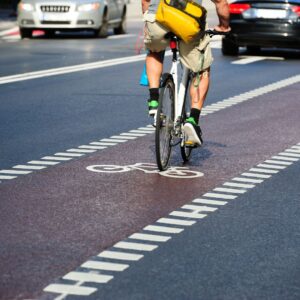 Use vehicular left turns when:
Use two-stage turns when:
There is no requirement to make vehicular-style turns. DC law explicitly permits two-stage turns as a legal alternative, and choosing this method does not constitute negligence or improper cycling.
If a vehicle hits you while you’re making a left turn on your bicycle:
DC is one of only five jurisdictions in the United States that still follows the strict contributory negligence doctrine. Under this harsh rule, if an injured person bears even 1% fault for a collision, they cannot recover any damages—even if the other party was 99% at fault.
However, the Vulnerable User Collision Recovery Amendment Act of 2020 creates a critical exception for cyclists and other vulnerable users. Under this exception, cyclists can recover damages even if partially at fault, as long as their negligence does not exceed 50% of the total fault for the collision.
This means DC uses modified comparative negligence for vulnerable users (50% rule) while maintaining pure contributory negligence for all other cases. The exception recognizes that cyclists face inherent vulnerability when sharing roads with motor vehicles and deserve greater legal protection than the strict contributory negligence rule provides.
Insurance companies frequently claim cyclists caused collisions by:
These arguments attempt to trigger DC’s contributory negligence rule and bar recovery entirely. An experienced bicycle collision attorney can counter these arguments by:
Bicycle collision cases often involve claims for:
The statute of limitations for personal injury claims in DC is three years from the collision date. However, evidence preservation begins immediately, waiting to consult a lawyer can result in lost video footage, faded memories, and disappeared witnesses.
According to DDOT crash data, 4,926 cyclists were involved in crashes from 2013-2022, with 73% sustaining injuries and 13 fatalities. DDOT’s bicycle safety data shows an average of 334 bicycle crashes annually over recent years.
Intersection-related crashes represent a significant portion of bicycle collisions in DC. Analysis of crash data shows that more than half of all serious bicycle crashes occur at intersections, where turning movements create conflict points between cyclists and vehicles.
The most dangerous intersections for cycling in DC include:
These intersections share common characteristics: high traffic volumes, unusual geometries, and multiple conflict points where vehicle and bicycle paths cross.
 The attorneys at Regan Zambri Long represent cyclists injured in DC traffic collisions, including crashes that occur while making left turns at intersections. We handle cases throughout the District and understand how DC’s bicycle laws protect your right to use roadways safely.
If you’ve been injured while cycling in Washington, DC, contact us for a free consultation to discuss your case. Call (202) 463-3030 or reach out through our website to speak with attorneys experienced in DC bicycle collision cases who will work to secure fair compensation for your injuries.


Have you or your loved one sustained injuries in Washington DC, Maryland or Virginia? Regan Zambri Long PLLC has the best lawyers in the country to analyze your case and answer the questions you may have.