
Call Us Now
202-960-4596
Schedule a Free Consultation


New York Avenue NE has a rare mix of risk factors for truck traffic. It serves as a major freight route into Washington, DC, while also carrying commuters, local drivers, delivery vehicles, pedestrians, cyclists, and people entering nearby businesses.
The corridor is dangerous because so many types of movement overlap in a short distance. Trucks may be trying to keep pace with through-traffic, while local drivers slow down, merge, turn, or look for access to nearby businesses. When traffic is heavy, a small mistake can leave a truck driver with very little room to stop, change lanes, or avoid a vehicle, cyclist, or pedestrian nearby.
If you were hurt in a truck crash on New York Avenue NE, a Washington, DC truck accident lawyer can help you understand the crash location, the vehicles involved, and the legal options available to you.
Few roads in Washington, DC, play as important a role in regional freight movement as New York Avenue NE. The National Capital Region Freight Plan identifies New York Avenue, US 50, as a Tier 1 freight route from the Maryland, DC line to I-395. This places the corridor on a recognized path for trucks moving between the District and the wider region. 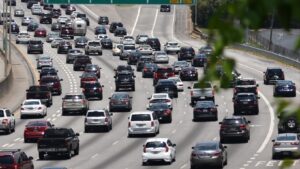
Its official freight role helps explain the range of commercial vehicles drivers may encounter there. A truck on New York Avenue NE may be serving a construction site, making a delivery, heading toward a commercial property, or connecting with another route deeper inside the city. Truck activity is part of the road’s daily function, rather than an occasional presence.
DC’s Safety Corridor was created for roadways where crashes and injuries call for focused attention. In 2025, officials selected New York Avenue NE from Bladensburg Road to 4th Street as one of the District’s first Safety Corridors. The program is a targeted traffic-safety initiative aimed at reducing crashes and saving lives on roads with documented safety problems.
The choice was based on more than general concern about heavy traffic. The first Safety Corridor on New York Avenue NE and South Capitol Street SW has seen 1,087 crashes, 427 injuries, and 2 fatalities since 2022, indicating major risks for all road users. The program also focused on roads where larger safety improvements were not already scheduled within the next five years, which gave the District a way to act sooner through enforcement, education, signage, and visibility.
The designation gives the corridor added significance for truck traffic. It confirms that this stretch had already drawn official safety concern, so a truck crash there should be examined with close attention to where it happened, how traffic was moving, and whether visibility, signage, or road layout contributed to the collision.
This stretch gives drivers very little room for hesitation. A truck driver may need to position a large vehicle well before an intersection, while nearby cars may be slowing, accelerating, changing lanes, or trying to move through congestion.
Side-street traffic and business access can add another layer of uncertainty. A driver entering New York Avenue NE may have only a short gap to join traffic, while a driver leaving the corridor may slow sooner than expected. When several drivers make those decisions around a truck, the corridor gives everyone less time to react.
Weight changes everything when traffic tightens. A loaded truck takes longer to slow down, needs a wider path through turns, and has less flexibility when conditions shift suddenly.
Those limits can have serious consequences on a corridor already complicated by intersections, side-street access, and stop-and-go movement. A truck may be moving at the same speed as surrounding traffic, but it cannot always stop, turn, or correct its course as quickly as a nearby passenger vehicle.
The DDOT District Freight Plan notes weigh-in-motion systems on New York Avenue NE, which collect vehicle volume and weight data. Their presence underscores why truck weight should be part of any discussion of safety on this corridor, not just the number of vehicles using the road.
A truck crash on New York Avenue NE may involve more than the driver behind the wheel. Commercial vehicles are usually part of a larger operation, so the company, employer, vehicle owner, maintenance provider, or cargo loader may also need to be reviewed. 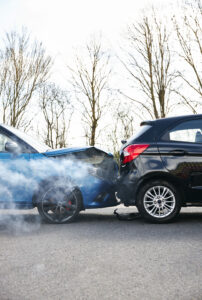
The driver may have turned unsafely, followed too closely, changed lanes without enough clearance, or moved too fast for the conditions on the corridor. A trucking company or delivery company may also come under scrutiny if poor training, scheduling pressure, weak supervision, or unsafe policies contributed to the crash.
Other causes may sit outside the truck itself. Maintenance problems, poorly secured cargo, another driver’s sudden movement, construction work, traffic controls, or missing signage may all need review, especially when the crash happened near an intersection, work zone, or commercial entrance on New York Avenue NE.
Safety comes first after a truck accident on New York Avenue NE. Move out of active traffic if you can do so safely, call 911, and ask for medical help if anyone may be hurt. Pain, concussion symptoms, back injuries, and internal injuries may become clearer after the scene has settled.
Record the location as precisely as possible. Note the nearest intersection, business, ramp, gas station, hotel, or landmark. Photos of the truck, license plate, company markings, damage, traffic signals, lane position, and road layout may help explain what happened.
Be careful with insurance conversations before the crash sequence is clear. A New York Avenue NE truck accident may involve driver conduct, company records, vehicle maintenance, route decisions, and corridor conditions.
If you were injured in a truck crash on New York Avenue NE, contact Regan Zambri Long for a free consultation. Our DC attorneys can review what happened, preserve key records, and explain your legal options.


Have you or your loved one sustained injuries in Washington DC, Maryland or Virginia? Regan Zambri Long PLLC has the best lawyers in the country to analyze your case and answer the questions you may have.