
Call Us Now
202-960-4596
Schedule a Free Consultation


Pennsylvania Avenue and 15th Street are part of daily life for cyclists in Washington, DC. Riders use these protected lanes to commute, reach downtown offices, travel between neighborhoods, pass major landmarks, and move through some of the city’s busiest corridors. The 15th Street lanes alone carry nearly 4,000 cyclists each day, and there has been a 46% drop in overall crashes and a 91% drop in bicycle injury crashes since those lanes were added.
Even with protected bike infrastructure in place, a collision can leave a cyclist facing urgent questions about what happened, who may be responsible, and whether DC law allows them to pursue compensation. The answer can depend on the lane design, the driver’s actions, the crash location, and whether anyone tries to blame the cyclist for part of the collision. A Washington, DC bicycle accident lawyer can help explain how local traffic laws, evidence, and the Motor Vehicle Collision Recovery Act may affect your rights after a crash on Pennsylvania Avenue or the 15th Street protected lanes.
Protected bike lanes create a clearer space for cyclists, but they still run through active downtown streets. Pennsylvania Avenue and 15th Street carry cyclists alongside drivers, pedestrians, delivery vehicles, buses, rideshare traffic, commuters, tourists, and government-related traffic. 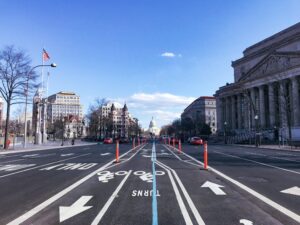
A crash can still happen when a driver fails to recognize the protected lane, misjudges how cyclists move through the corridor, or focuses on surrounding traffic while overlooking cyclists in the lane. The protected lane may reduce some risks, but it still depends on drivers’ understanding of where cyclists are and yielding when the law requires it.
For cyclists, this means that a crash in or near a protected lane alone does not answer the legal question. The more important question is what the driver saw, what the driver should have seen, and whether the driver acted safely before the collision.
Cyclists have the right to use DC bike lanes without drivers treating those lanes as spare parking, loading space, or an afterthought during a turn. A protected lane gives cyclists a designated place to ride. Drivers still have to look, yield when required, obey signs and signals, and account for cyclists before crossing or entering that space.
This becomes especially important when a driver turns across a protected lane. A cyclist may be traveling straight with the flow of the bike facility while a driver attempts to turn through the cyclist’s path. The driver may later claim the cyclist appeared suddenly or was difficult to see. The legal question is whether the driver checked the lane, followed the signal, yielded properly, and made the turn only when it was safe.
Blocked lanes create a different legal issue. When a delivery driver, rideshare driver, parked vehicle, or stopped car blocks the protected space, the cyclist may have to slow suddenly, stop, or move closer to traffic. If a crash follows, the key question is whether the driver’s decision to occupy or interfere with the bike lane created the danger that led to the collision.
DC’s Motor Vehicle Collision Recovery Act gives cyclists important protection when fault is disputed after a crash. The Act is set out in DC Code § 50-2204.52, which limits the application of DC’s contributory negligence rule to covered collisions involving pedestrians and vulnerable users, including bicyclists. Contributory negligence can block an injured person’s claim if they share any fault, but the Act creates a different rule for these vulnerable road users.
Under that rule, a cyclist is not automatically barred from bringing a claim just because someone argues they were partly at fault. The cyclist’s share of blame must be greater than everyone else’s who caused the crash before the law blocks recovery. In practical terms, an insurer cannot defeat the claim simply by pointing to one thing the cyclist may have done wrong.
This distinction can be crucial for cyclists on Pennsylvania Avenue or 15th Street. A driver or insurer may argue that the cyclist was riding too fast, entered the intersection at the wrong time, moved outside the lane, or reacted too late. Those arguments still need to be investigated, but partial blame alone should not automatically end the claim. The issue becomes whether the evidence supports putting most of the blame on the cyclist, or whether the driver’s conduct, the road layout, and the surrounding circumstances tell a different story.
Bike lane gaps, closures, or detours can affect fault after a collision because they may explain why a cyclist was outside a protected lane, riding closer to traffic, or moving through an unusual connection point. A driver or insurer may focus on one moment in the crash and argue that the cyclist was in the wrong place, but the fuller question is why the cyclist was there.
On 15th Street NW, that issue is especially clear because the cycle track has a gap from New York Avenue NW to Vermont Avenue NW. Cyclists may use Pennsylvania Avenue NW and a connection through Lafayette Park, but that connection sits within the White House security perimeter and may be closed for certain events or functions. When that happens, cyclists may have to use sidewalks or ride into oncoming traffic on 15th Street NW to reach other cycle track segments.
Similar questions can arise when construction changes the route, temporary barriers narrow the available space, security closures affect the usual connection, or signage sends cyclists into a less predictable position. Those details do not decide fault on their own, but they can help show whether the cyclist was acting carelessly or responding to the conditions in front of them.
Regan Zambri Long’s bicycle accident lawyers can help cyclists understand their rights after a crash on Pennsylvania Avenue, 15th Street, or another protected bike lane in Washington, DC. Contact us for a free consultation, and we will explain your rights, preserve key evidence, and help you pursue compensation after a crash.


Have you or your loved one sustained injuries in Washington DC, Maryland or Virginia? Regan Zambri Long PLLC has the best lawyers in the country to analyze your case and answer the questions you may have.